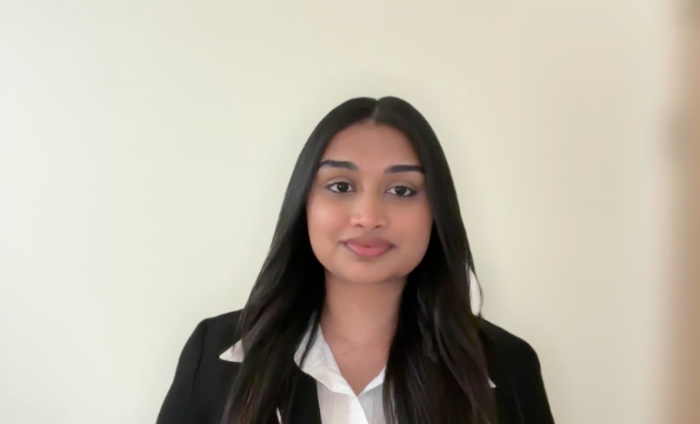
As part of UCL School of Management’s 2026 International Women’s Day commemorations, we’re spotlighting members of our fantastic community who are driving impact across industries and ecosystems worldwide. We recently caught up with Sabah Khan, a recent graduate of the MSc Business Analytics programme, who has launched her career in data with a Data Analyst role at Marks & Spencer.
From discovering her passion for analytics at UCL School of Management to gaining hands-on experience through industry projects, mentoring opportunities, and community roles, Sabah reflects on her journey into data, the evolving gender landscape within the field, and her hopes for a more inclusive future for women and girls pursuing careers in technology.
tell us about yourself
Hi, I’m Sabah. I was born and raised in Mumbai, then moved to Paris for my undergraduate studies before coming to London to complete my MSc in Business Analytics at UCL School of Management.
Soon after my programme finished, I joined Marks and Spencer as a Data Analyst, where I’m currently working. In my role, I focus on analysing customer data across the business to generate insights that support strategic business decisions.
how was your time studying with ucl school of management?
My experience at UCL SoM has been extremely rewarding. The programme introduced me to the idea of pursuing a career in data analytics - something I was honestly quite intimidated by before starting my MSc.
What I really loved was how practical and industry-focused the MSc Business Analytics programme was. We had opportunities to work on real business projects, collaborate with companies while getting a chance to build a network with students of different cultural and professional backgrounds.
Beyond academics, the experience helped me grow personally and professionally. I had the opportunity to take part in a reverse mentoring programme with Chanel, where I connected with industry experts. Alongside that, I took on a part-time role as a Social Media Ambassador for UCL School of Management’s social media team, which helped me develop story telling and digital communication skills.
I developed new skills outside the classroom. It pushed me out of my comfort zone, built my confidence, and motivated me to take on opportunities I might not have otherwise considered.
how do you find the gender balance in data analytics?
Data analytics has historically been male-dominated, particularly in more technical areas, but I’ve genuinely seen positive change over the last few years.
Something I observed at my current role is the strong presence of women leading data teams across data science, analytics and leadership. To me, this is extremely inspiring.
What stands out to me is the growth of women-led data communities - such as Women in Data. I truly find collaborative events, networking opportunities and forums where women can connect, learn and lead data space extremely inspiring.
It excites me about the future and growth opporunities for those - like me - who are just starting out in their data analytics careers. I’m excited about where the industry is heading — not just in terms of technical innovation, but in building a more inclusive, collaborative data community.
Are there any areas of equality or social justice you’re particularly passionate about or would like to see improved?
One area I’m especially passionate about is improving gender representation in data and technology. While progress has been made, there’s still a gap in leadership roles and technical spaces. I’d love to see more structured pathways, mentorship, and sponsorship opportunities that actively support women — especially those from diverse cultural and socio-economic backgrounds - and give them the opportunity to explore, learn and thrive in this field.
I’m passionate about creating a space where women and girls feel empowered to speak up, contribute their ideas, and collaborate with confidence.