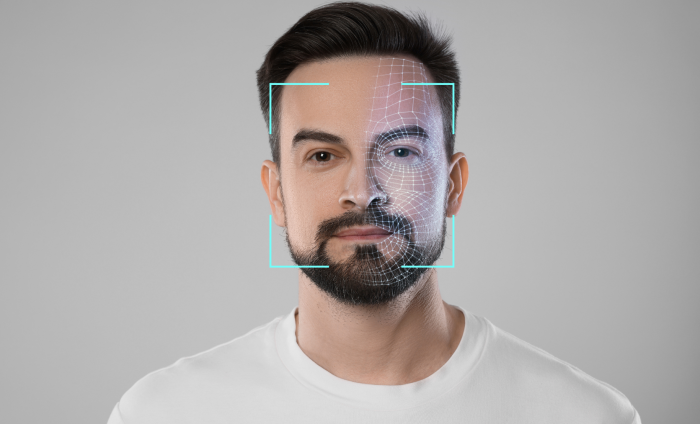
For researchers, analysing huge datasets about human emotions is complicated and often approximate. While humans have evolved to recognise and interpret each other’s facial expressions to incredible levels of detail, this can be difficult to translate when overseeing much larger volumes of data.
In a new paper co-authored by UCL School of Management academic Dr Vivianna He, artificial intelligence is presented as a valuable tool to open up new and exciting ways for researchers to study emotions on a grander scale.
Recently published online in the Academy of Management Journal, the paper explains how researchers could leverage Algorithmic Facial Expression Analysis (AFEA), a technology that uses machine learning to analyse facial movements captured on video, to better study human emotions and advance theories about them.
Rather than replacing human judgement, the authors argue that the technology offers researchers a powerful new tool for examining emotional processes that are often too subtle, fleeting or complex to measure in quantity using conventional methods.
Emotions play a central role in leadership, teamwork, decision-making and negotiation, yet most research currently relies on surveys, interviews or observations that capture only a snapshot of how people feel and which can be much harder to judge without face-to-face contact with every single surveyed person.
The authors argue that many theories of workplace behaviour depend on emotions unfolding over time and, while researchers have traditionally had limited ways of observing those processes directly. AFEA offers a different approach.
By analysing facial movements frame by frame, it can identify emotional expressions as they emerge, peak and fade, generating a continuous stream of data rather than a single observation.
This allows researchers to examine the timing and structure of emotional responses with a level of precision that would be difficult for even highly trained human observers to achieve consistently and at scale.
A particular advantage lies in the technology’s ability to detect rapidly changing expressions and micro-expressions, brief facial movements that can last for fractions of a second.
According to the researchers, algorithmic analysis makes it possible to systematically study these momentary emotional shifts and what they reveal about communication, influence and social interaction.
The paper identifies two major research opportunities. The first is the ability to track the temporal structure of emotions, allowing scholars to study how emotional reactions develop over time and spread between individuals. The second is the ability to detect differences between genuine and managed expressions, creating new opportunities to investigate emotional labour, trust and interpersonal influence in organisational settings.
The authors argue that these capabilities could help advance research across fields including leadership, entrepreneurship, strategy and organisational behaviour. They also provide a practical framework and toolkit designed to help researchers apply the technology in a rigorous and transparent way.
At the same time, the paper stresses that facial expressions cannot be understood in isolation. The researchers note that context remains essential when interpreting emotions and caution that facial analysis should be combined with other sources of evidence rather than treated as a direct measure of what a person is thinking or feeling. They also highlight ethical considerations around the collection and use of video data and call for careful, transparent research practices.
Vivianna He, Associate Professor of Strategy and Entrepreneurship at UCL School of Management, said:
“Growing up with autistic traits, I often found human emotions difficult to read, and that experience shaped my fascination with how emotions can be studied more carefully and systematically. In our paper, we show that algorithmic facial expression analysis can be a powerful research tool for understanding how emotions unfold over time and how authentic emotional expressions may be in organizational life.
“But because this technology reaches into something deeply personal, we must use it with strong ethical safeguards—so it advances knowledge and empathy, rather than becoming a tool for surveillance.”
The paper, Algorithmic Facial Expression Analysis: A Novel Methodology to Advance Management Research on Emotions, was co-authored by Silvia Stroe, Charlotta Sirén, Vivianna He, Barbara Burkhard and Vangelis Souitaris.
