With artificial intelligence capabilities developing at a rapid pace, many sectors are racing to embrace the technology, asking themselves how best to adopt, evaluate and roll out AI effectively and efficiently.
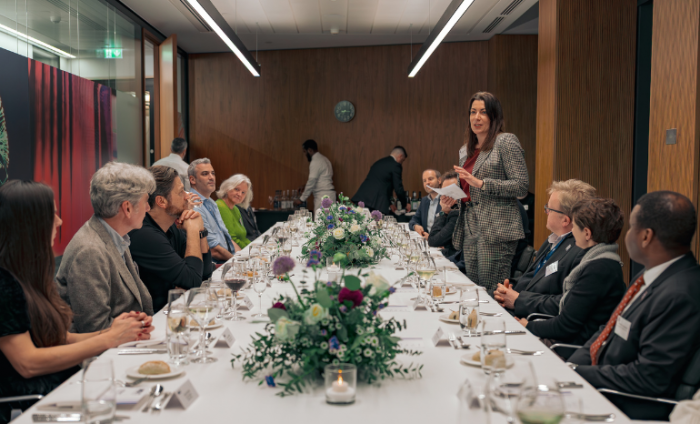
This was the central discussion at a recent high-level dinner hosted by the UCL School of Management, with senior leaders representing various sectors, from global corporations including Nvidia, Huma, Google and the Tony Blair Institute attending. Participants debated, reflected on and learnt from each other how to create innovation and enable the transition of knowledge across sectors and industries. Senior leaders from across UCL joined the discussion, including the Vice-Provosts of Health, and Research, Innovation and Global Engagement, and the Vice-President of Operations.
Central to the cross-sector discussion was the role UCL can play in the future AI ecosystem. The evening focused on nine themes, starting with reframing AI adoption from ‘how do we adopt AI’, to working out what problems need to be solved and what outcomes need to be delivered, and what barriers are in place – and what the best solutions are, which may not necessarily be AI.
Other themes focused on governance and policy, productivity expectations, constraints and outcomes, people and process, pharma and investments, the ‘jagged frontier’ concept of inconsistent AI success, societal narratives and the future of AI, and market forces.
UCL School of Management’s Professor Angela Aristidou, who led the evening with Dr Eva-Maria Hempe, Executive Director, Public Services EMEA at Nvidia, said: “As someone who studies how AI is deployed within complex organisations around the world, I saw this event as a powerful example of the boundary-crossing we need – bringing together academics, corporate leaders, investors and policy makers to move AI from promise to practice.”
Dr Hempe said: “We are currently at a critical inflection point when it comes to AI. For the last two years, the conversation has been dominated by possibility – what the models could do. But for large organisations from pharma to public sector, the reality is much harder.
“I wanted to convene a room that didn’t just celebrate the technology, but have an honest conversation on what can be done today in production as well as dissecting the barriers to further scale out. We deliberately curated a collision of worlds: the ‘builders’, the ‘buyers’, the ‘funders’ and the ‘policymakers’. The core issue we tackled was the tension between quick wins (efficiencies, chatbots) and deep transformation (curing disease, sovereign capabilities).”
The dinner took place the night before UCL’s 200-year anniversary. Professor Geraint Rees, Vice-Provost, Research, Innovation & Global Engagement at UCL, said: “It’s incredibly fitting that UCL is hosting such a high-level, essential discussion on the future of AI on the eve of our bicentenary. UCL has always offered a foundation built on diversity and innovation from people who think differently, and a commitment to ‘useful knowledge’ applied for the greater good, not just for innovation in its own right.”
Around the room, there was strong agreement that AI must be understood within the relationship between people, process and technology, that leadership and culture are decisive factors, education is central to effective adoption, and crucially, we need to understand that not all problems require AI as a solution.
Participants agreed that regardless of innovation and developments in AI, there will always be new problems to solve. They also agreed that true innovation is uncomfortable in nature because it disrupts value chains. Finally, participants agreed that the future will be shaped by those who engage actively rather than passively.
Professor Aristidou continued: “Our candid discussion reflected a shared recognition that while AI technologies are advancing at remarkable sped, our capita models, governance frameworks and organisational capacities are struggling to keep pace. Crucially, collective efforts across industry leaders, researchers, and policymakers is what will ensure we scale AI in ways that support the majority of organisations, including those that may stand to benefit the most yet risk being left behind.”
Dr Hempe concluded: “This dinner confirmed that we need to move the conversation from ‘hype’ to ‘how’. The next phase is about the unglamorous but critical work of data curation, energy resilience, and governance. We hope the connections made in this group tonight persist as a ‘community of practice’ to share honest notes on what is actually working, away from the sales pitches.”
