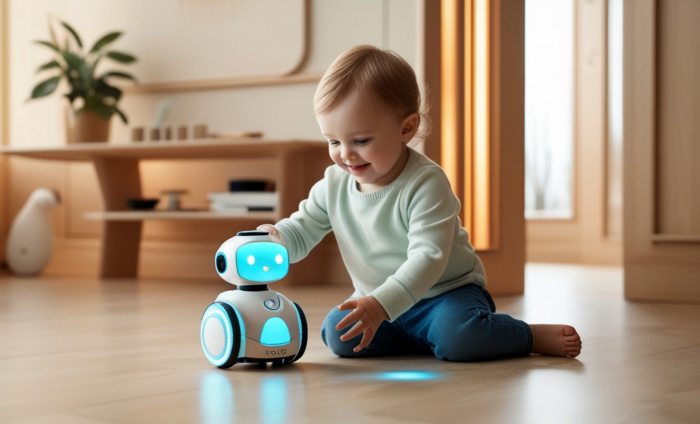
Does the future of humanity involve artificially intelligent babies? The idea may seem farfetched or alarming, even by today’s standards of increased AI influence on our everyday lives. Yet many Silicon Valley tech leaders and AI researchers consider it a genuine and serious discussion.
UCL School of Management’s Dr Angela Aristidou has provided her own expert insight to a Guardian ’the big idea’ article exploring this provocative concept of “mind children” — AI-generated or post-biological offspring that would hypothetically reshape human reproduction.
Science writer Laura Spinney examines these growing discussions in Silicon Valley about a future in which advances in artificial intelligence may reduce or even replace biological procreation.
In the article, Spinney identifies a particular fixation with the 1988 book Mind Children by Hans Moravec, popular among many Silicon Valley researchers. Moravec’s book is a philosophical insight (rather than a technological manual) and argues that humanity has entered a stage of cultural, rather than biological evolution. For Moravec—and clearly many Silicon Valley thinkers—the next stage of humanity will be digital and artificial offspring.
Dr Aristidou suggests that this belief is not uncommon among tech-types and that she is not surprised Moravec’s book is experiencing a revival. If some people are already starting relationships with their chatbots, “why wouldn’t they also devise their ideal child?”, Angela said.
Angela expressed legitimate concern about viewing AI in this substitutive manner, adding that AI, as it stands, naturally has much larger corporate developers behind it. Which would mean there are “three entities in this relationship: the human, the AI companion, the AI developer.”
Read the full article: Are ‘mind children’ the future of reproduction? — The Guardian, 31 May 2026.
