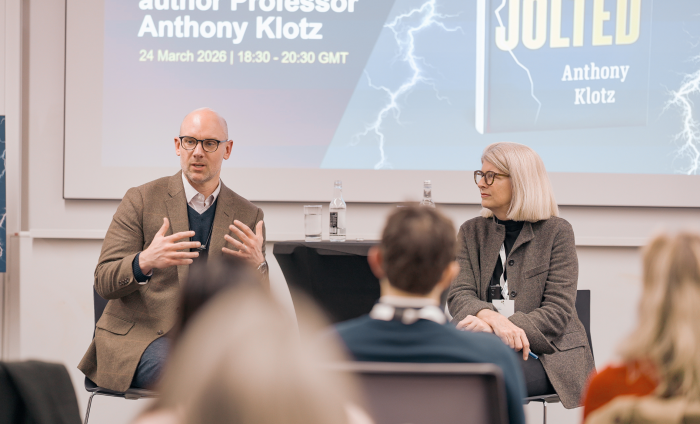
Last night, The School of Management celebrated the launch of Dr Anthony Klotz’s bold and insightful new book Jolted, bringing together esteemed colleagues, media guests and industry partners on Level 50 of One Canada Square for an evening of thoughtful discussion about the science behind why we quit our jobs.
The event opened with a welcome from Jeremie Brecheisen of Gallup, who spoke about Dr Klotz’s longstanding contribution to research on work and behaviour, and who introduced him with warmth and humour, including a short reflection on his strengths as a learner and his general curiosity.
Dr Klotz then took part in an in‑depth conversation with Financial Times journalist Pilita Clark, who has followed his work for several years, describing him as ‘an extremely generous academic’.
Their wide‑ranging conversation explored the book’s central idea that career shifts are usually sparked by sudden ‘jolts’ rather than slow and rationalised processes, with these jolts originating in workplace failures, colleagues’ departures, personal events or unexpected moments of opportunity.
Klotz spoke openly about his own experiences, including an early management misstep that taught him the value of listening, and the rapid attention that followed his prediction of the Great Resignation. Klotz emphasised that speaking up is often wiser than acting hastily and managers who pay attention to early signs of withdrawal are better placed to prevent unnecessary turnover.
During the Q&A Klotz reflected on the rise of remote work and the growing influence of AI as a potential oncoming jolt for many people, with Klotz viewing AI as a catalyst that forces many workers to reassess their career trajectory. Some people view AI as a threat that may render parts of their role obsolete, while others see it as an opportunity that could make their work more rewarding. This split reaction mirrors the wider pattern of jolts that provoke re-evaluation rather than immediate resignation.
Klotz also predicted that the rise of AI will spark more experimentation outside traditional employment. As people weigh whether to embrace AI within their existing roles, many will test parallel ventures or passion projects. These exploratory moves function as a response to the uncertainty AI brings and reflect a desire for greater autonomy.
Following the launch of his new book Jolted, we sat down with Dr Anthony Klotz for our own Q&A to discuss the book and the science behind why people leave their jobs.
What inspired Jolted?
The book really stemmed from my interactions after coining “the Great Resignation”—the prediction that the covid-19 pandemic would cause a global spike in resignations. That prediction was based on my observations of how workers were coping with the pandemic, along with academic research—some of it my own, much of it by others—on why people quit their jobs.
In the years after the Great Resignation, I spent a lot of time speaking with executives, HR leaders, employees, and media outlets. People would ask why I made that prediction, and when I unpacked the research behind it, they were often surprised.
Insights such as turnover being contagious or the reality that people most often quit during their first year in a job were not widely understood. And the biggest insight—that people often quit because of a specific event or “jolt,” not gradual dissatisfaction—wasn’t well-known at all.
I realised there was a gap between what we know academically about quitting and what people understand in practice. This book is my attempt to close that gap and help workers and leaders navigate these confusing, often emotional moments.
In the book, you outline six types of ‘jolts’. Could you tell us more about those?
Absolutely. First, it’s important to note that experiencing a jolt doesn’t automatically mean you’ll quit. Jolts simply cause us to stop and question our relationship with work.
So the first type of jolt is what I call Direct Jolts. These are negative events that happen directly to you at work—failure, mistreatment, or even subtle rudeness. A single rude comment can make you ask, “Do I belong here?”
The next type involves jolts that happen to people around us – Collateral Jolts. If a coworker who is also your friend quits, your job instantly becomes less enjoyable. If layoffs occur, even if you’re not affected, you often feel guilty and wonder if you’re next. Even witnessing others being treated poorly can be jolting.
The third type (perhaps my favourite) is what’s called Honeymoon Jolts. Counterintuitively, people are actually more likely to quit during their first year in a job than any other year. That’s because expectations built during hiring often clash with reality, leading to regret. Many people even “boomerang” back to their previous employer.
Outside of the work domain we have jolts that affect our personal lives – Crossover Jolts which are events related to health issues, family needs, or even a partner telling us we’ve become consumed by work. These can force us to reevaluate how we balance our time between work and everything else.
Remote Jolts are tragic events that happen far away, often involving death or loss. They make us reflect on life’s fragility and whether we’re spending our time meaningfully. They’re often more powerful when the event involves a group that we identify with.
Lastly most jolts are negative, because humans are wired to pay more attention to negative events. But Positive Jolts—like receiving a promotion—can also prompt reflection. When we’re in a positive state, we’re more open-minded and consider more life possibilities, sometimes leading to epiphanies and major career changes.
Were there any insights from the book or your research that you wish you’d known earlier in your own career?
In the book I describe a moment early in my career when, at a management conference, I discovered that three of my colleagues were interviewing elsewhere. It was an emotional roller coaster, and I reacted a bit hastily.
A school that had been recruiting me reached out again, and even though I had been happy in my role, I agreed to talk. A few months later, I had interviewed and accepted a new job. To be clear, it was the right career move, but the speed and abruptness of it were jarring—especially for my wife, since we were very embedded in our community.
Looking back, I wish I’d processed those jolts more thoughtfully. The first thing I now advise in the book is, after experiencing a jolt, to take a moment before making any big decisions, think it through, and talk to someone you trust before acting. I kept everything mostly to myself and made a quick decision; the outcome would likely have been the same either way, but the process could have been better.
From an organisational perspective, what can leaders do to prevent a domino effect when a key person leaves?
There are a couple of actions leaders can take. The first is to treat the departing employee well. Many organisations don’t have a plan for offboarding. Leaders often respond to resignations in dysfunctional ways. But if you treat high-performing leavers generously, they’re less likely to encourage others to follow them. Some companies even offer top performers a one-year leave of absence so they can return easily, a strategy that also reduces the risk of turnover contagion.
The other action is to support the employees who stay. Leaders sometimes get quiet or withdrawn after losing a top performer. Instead, they should speak up, show vulnerability and acknowledge the impact:
“I know losing this person is painful and I know you worked closely with them, so it’s going to affect you directly. I just want to listen to how you’re experiencing work right now” …
The stayers may also reveal more about the real reasons someone left than you’d hear in an exit interview. They may mention adjusting workloads, supporting wellbeing, or addressing other underlying issues, which can help reduce further departures.
Is there a “best way” to quit a job?
The best way is definitely face-to-face or via video call, not by email or text. My research shows that email resignations feel avoidant and can easily be misinterpreted.
Give a reasonable amount of notice—it varies by country and industry, but it should feel respectful. Share at least a little about what you’re doing next; even brief transparency goes a long way.
Two optional “upgrades” can make your resignation even better. One would be to mitigate disruption by offering to help train your replacement or be reachable briefly after leaving.
The other one can be risky and should only be done if you have a trusting relationship with your manager and you are not leaving for a competitor. But if you give your manager a heads-up that you are going to resign before doing so, this can also ease the process.
On the flip side, what are some of the worst ways to quit?
Bad resignations usually involve being completely secretive about your next steps, resigning via email or message, or bad-mouthing the organisation and its leaders or your manager.
Ghosting or walking out is often assumed to be the mark of a “bad worker,” but my research shows it usually follows a severe direct jolt—unfair treatment or abusive supervision. One person told me their manager insulted their daughter and in response, the worker simply set his keys on the desk and left. Such situations highlight just how intense jolts can be.
Jolted is often dealing with meaning inside and outside of work. How do you personally find meaning?
For me, meaning comes from having a positive, useful impact on others—students, colleagues, and people in the profession. When I spend months focused solely on my own research, the work starts to feel less meaningful.
Outside work, my life is mostly about investing in meaningful partnerships—with my wife, with close friends, and with the community where I live. Plus supporting West Ham, of course!
In the book, I talk about balancing the micro and the macro: on a daily basis, do we enjoy what we’re doing and who we’re doing it with? And on a bigger scale, is our work helping others and society in a way that we find meaningful?
A big role of leadership is to help people see how our often small, everyday tasks contribute to that meaningful bigger picture.
